Fitness App - Liftalot
Shipped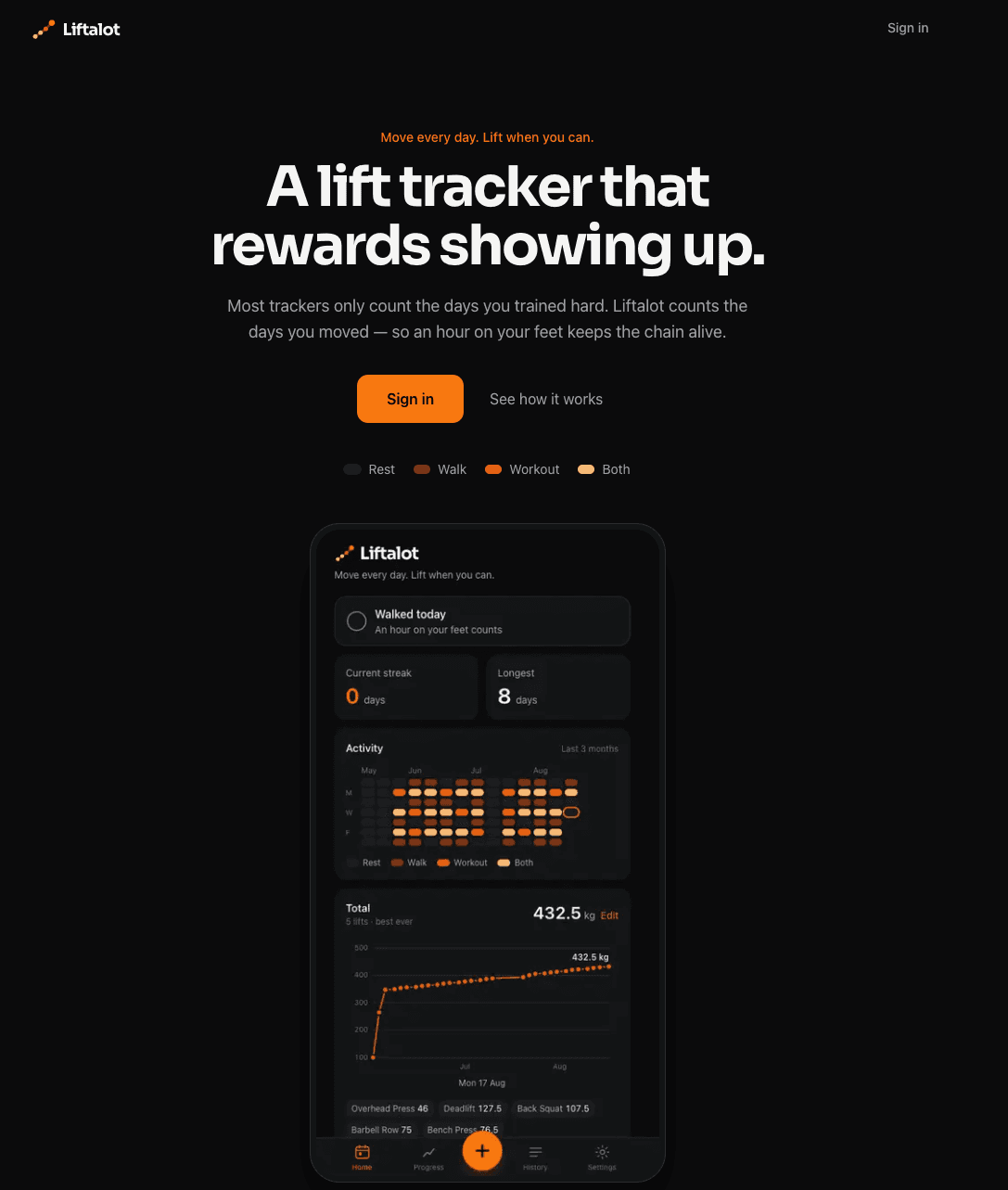
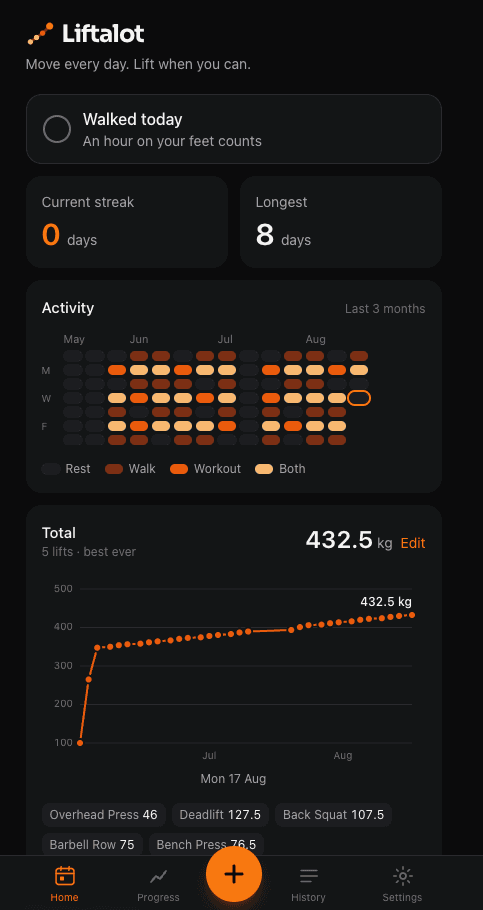
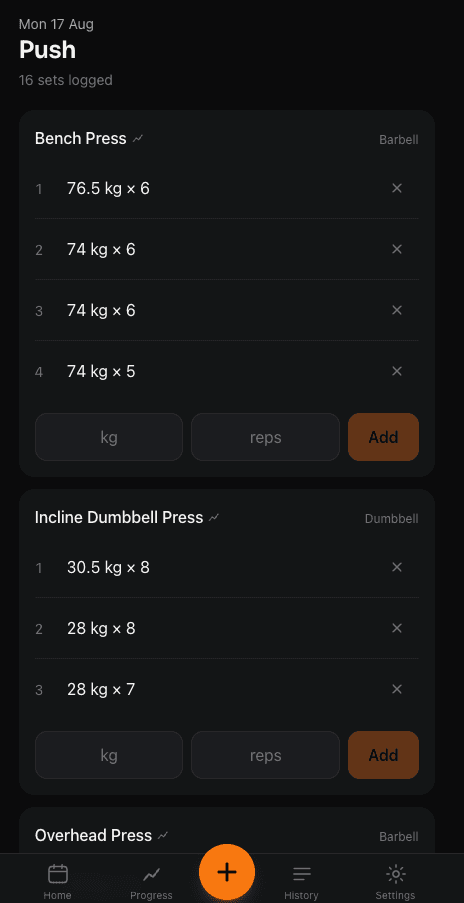
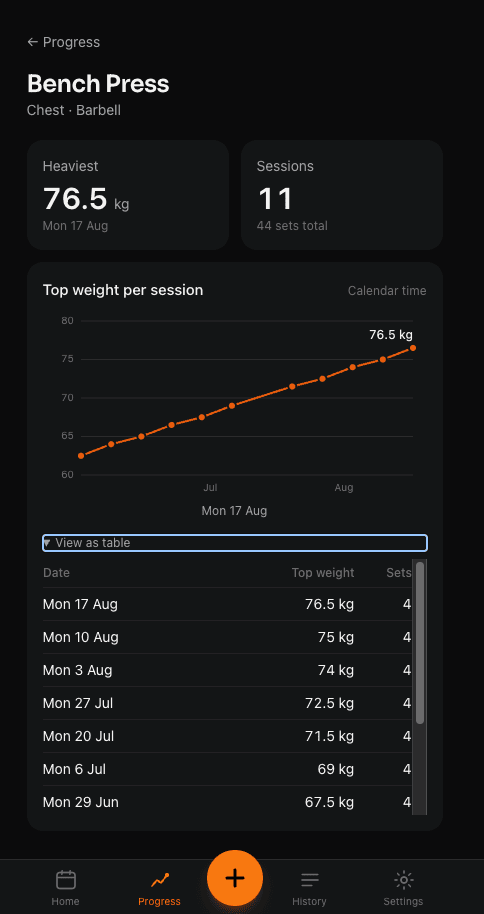
It lets you log workouts, track your lifts, and visualise your progress over time, while also counting walking and everyday movement towards your activity streak. The idea behind the project was to build a fitness tracker that encourages showing up without punishing rest days. It deliberately leaves out features like estimated 1RMs, programme builders and excessive statistics in favour of a simple experience centred around logging workouts and seeing your progress.
Roadmap
13 of 19 completeHow Liftalot got to where it is, and the two things it still needs. The shipped phases are a record; the last two are the plan.
Foundations
Decide what the app refuses to do before writing anything, because that is the whole product.
- Done
Scaffold Next.js and TypeScript
App Router, strict TypeScript, Tailwind. Mobile-first from the first commit, since every real use of this app happens on a phone.
- Done
Write down what it will not have
No estimated 1RMs, no programme builder, no wall of statistics. Deciding this first is what kept the logging screen fast.
- Done
Model a workout
A workout holds exercises, an exercise holds sets, a set holds reps and weight. Shallow enough that logging never needs more than two taps.
- Done
Accounts and persistence
Sign-in and per-user storage, so a training history survives a new phone. The one piece of infrastructure the app genuinely needs.
Log a workout
The core loop. If this is slow, nothing else in the app matters, because the log stops being accurate.
- Done
The logging screen
Add an exercise, add sets, enter reps and weight. Built to be usable one-handed, between sets, without looking up.
- Done
Prefill from last time
Most sets repeat what you did last session. Starting from those numbers turns logging into confirming rather than typing.
- Done
Exercise library
A searchable list of movements with your own additions, so the same lift is named the same way every week and history actually joins up.
Show up, don't be perfect
The part that makes it Liftalot rather than another logger — rewarding consistency without punishing a rest day.
- Done
Activity streak
A streak that counts showing up, not intensity, so an easy session still counts and one missed day is not a reset.
- Done
Count walking and everyday movement
A long walk is not a wasted day. Counting it towards the streak is what stops the app quietly telling you that only lifting is real training.
- Done
Progress over time
Per-lift charts showing the trend, not a dashboard of derived metrics. Enough to see you are moving without inviting you to over-analyse.
Ship it
Cheap, quick, and the difference between a repo and something you actually open at the gym.
- Done
Welcome and onboarding
A short first-run flow that explains the streak rules up front, since the rest-day behaviour is the bit people do not expect.
- Done
Tune it for a phone at the gym
Large tap targets, no hover-dependent controls, and a layout that survives being used with one thumb and chalky hands.
- Done
Deploy to Vercel
Preview deployments per branch and a live demo anyone can open without signing up first.
Notes on the work itself
Numbers record what you lifted. They do not record that your shoulder felt off, or that the bar moved better at a slower tempo.
- Planned
Add notes to each exercise
A free-text note per exercise in a session — form cues, niggles, how it felt. The context that makes last week's numbers mean something.
- Planned
Surface the last note while logging
A note you cannot see next time is a note you did not need to write. Showing the previous one inline is what makes the feature pay off.
- Planned
Keep it optional and out of the way
Notes must not add a step to the common path. Collapsed by default, one tap to open, never a field standing between you and the next set.
Works without a signal
Gym basements do not have wifi. An app that loses a session to a dead connection stops being trusted, and a tracker you cannot trust is worse than a notebook.
- Planned
Write to local storage first
Every set is saved on the device the moment it is entered, with the server as a sync target rather than the source of truth. Nothing is ever lost waiting on a request.
- Planned
Installable offline shell
A service worker caching the app shell and the exercise library, so it opens and logs with no connection at all — not just when a request happens to fail.
- Planned
Sync when the connection returns
A queue that drains on reconnect. Sets are append-only and single-user, so ordering by timestamp resolves nearly everything without real conflict handling.
Screens